
A practical brewing guide from Beyoğlu Lokum & Coffee
Quick answer: For one small cup of Turkish coffee, start with 7–8 g of extra-finely ground coffee and 65–75 ml of water. Stir them together in a cezve before heating, warm gently, and remove the pot as the foam rises, before a vigorous boil. Pour slowly and let the grounds settle before drinking.
Turkish coffee is a brewing method, rather than a coffee-bean variety. The coffee and water heat together in a small pot; there is no paper filter, and the grounds remain in the cup. A successful brew depends on the grind, dose, pot size and heat control—not on boiling the coffee three times.
This guide covers a repeatable starting recipe, gas and electric stovetops, induction compatibility, foam, sugar and the most common brewing problems.
1. What do you need to make Turkish coffee?
You need a cezve, coffee ground almost to a powder, clean drinking water and a controllable heat source. A small kitchen scale makes the recipe easier to repeat.
A cezve, also often called an ibrik in English-language coffee shops, is the small, long-handled pot used for this method. Choose a size appropriate to the number of cups you are making. Leave room above the liquid for the foam to rise.
Coffee intended for a filter brewer, French press or most espresso preparations is not an equivalent substitute for the characteristic extra-fine Turkish grind. The particles stay in the drink and settle after serving, which is part of the method's distinctive texture.
You can add sugar, but it is optional. The recipe works without it.
2. Turkish coffee ratio: how much coffee and water per cup?
A useful starting point is approximately one part coffee to nine or ten parts water by weight. For a simple first attempt, use 7 g of coffee and 70 ml of water.
The Turkish Coffee Culture and Research Association recommends about 7–8 g of coffee per portion. Specialty Turkish Coffee's contemporary guide uses 7 g to 70 g of water. These are starting points you can adjust to your taste, rather than one compulsory recipe.
| Small servings | Ground coffee | Water | Serving cups |
|---|---|---|---|
| 1 | 7–8 g | 65–75 ml | 1 |
| 2 | 14–16 g | 130–150 ml | 2 |
| 3 | 21–24 g | 195–225 ml | 3 |
| 4 | 28–32 g | 260–300 ml | 4 |
The water figures describe what goes into the pot, not a guaranteed finished beverage volume. Evaporation and liquid retained with the grounds affect the yield.
If you use spoons, keep the same spoon and level of filling between brews. A heaped teaspoon is an imprecise measure because spoon sizes and the density of the grounds vary.
To make the drink stronger, increase the dose slightly—for example, from 7 to 8 g for the same 70 ml of water. Prolonged boiling is not a good way to correct an under-dosed brew.
3. How to make Turkish coffee on the stove: step by step
Ingredients for one small cup:
- 7 g of extra-finely ground coffee;
- 70 ml of drinking water;
- sugar, if wanted.
Step 1. Measure the water
Pour 70 ml of cool or room-temperature water into the cezve. Cool water is a convenient starting point when you are learning to watch the gradual rise in temperature.
Use the same measured amount when repeating the recipe so you can compare results.
Step 2. Add coffee and optional sugar
Add 7 g of coffee. If you want a sweetened drink, add the sugar now, before heating.
Stir gently to distribute the grounds and break up dry clumps. You do not need to keep stirring once the pot is on the stove.
Step 3. Heat gently
Place the cezve over a low, controlled heat. Small bubbles and foam will develop as the mixture warms.
Stay with the pot. The final rise can happen quickly, particularly with a small batch or a powerful burner. Brewing generally takes a few minutes, but there is no universal timer setting for every pot and stove.
Step 4. Remove the pot as the foam rises
Lift the cezve off the heat when the foam begins rising towards the neck. Do not wait for sustained, vigorous bubbling.
For several cups, you can distribute some foam first and briefly return the pot to gentle heat. This is a traditional variation, not a requirement to boil the coffee repeatedly.
Step 5. Pour and let the grounds settle
Pour slowly into small coffee cups, aiming to preserve the foam. Turkish coffee cups, or fincans, are often around 60–90 ml.
Wait about a minute for much of the sediment to settle; give it longer if the particles are still moving. Do not filter the drink or stir up the grounds between sips. Leave the dense sediment at the bottom.
4. Gas, electric or induction: what changes?
The ingredients and sequence stay the same. What changes is how quickly the heat source responds.
| Stovetop | Main consideration | Practical approach |
|---|---|---|
| Gas | An oversized flame can heat the sides and handle | Use a stable small burner and a low flame; lift the pot as the foam rises |
| Electric coil or ceramic | The surface can remain hot after the control is reduced | Physically remove the cezve rather than relying only on turning down the heat |
| Induction | The base must be compatible with the hob | Use an induction-compatible cezve or a suitable adapter according to its instructions |
On a gas stove, keep the flame beneath the base. On a ceramic surface, use a stable, flat-bottomed pot suitable for that surface. An ordinary copper cezve without a compatible base may not work directly on induction.
There is no single correct power level for every stove. Watch the coffee, rather than treating a dial number as a recipe.
5. How do you get foam on Turkish coffee?
Good foam starts with the right grind, an appropriate dose, a suitably sized pot and controlled heat. Freshness also matters: opened ground coffee can lose aroma and gas during storage.
Turkish coffee foam is not espresso crema. It forms while a suspension of coffee and water heats, rather than under an espresso machine's pressure.
For a more consistent result:
- use coffee prepared for Turkish brewing;
- leave headroom in the cezve;
- stir before heating, then avoid continuous agitation;
- watch for the rise and remove the pot promptly;
- pour gently instead of allowing a rolling boil to break the foam.
Should you boil Turkish coffee three times?
No. Some traditional preparations include more than one rise of the foam, with the pot removed between rises. A repeated rise is different from prolonged vigorous boiling.
For a beginner, one controlled rise is a sensible method to master. More foam does not, by itself, prove better beans or a better-tasting drink.
6. Should you start with cold or hot water?
Cold water appears in traditional descriptions, including UNESCO's account of Turkish coffee culture. Room-temperature water is also used, and contemporary specialty methods may use preheated water to manage brewing time.
Start with cool drinking water if you want an easy way to observe the gradual heating process. Once your recipe is consistent, you can explore a different starting temperature while controlling the other variables.
Water temperature alone does not guarantee foam. Grind, freshness, dose, pot geometry and heat input all affect the result.
7. When do you add sugar to Turkish coffee?
Add sugar before the cezve goes on the stove, so it can dissolve without disturbing the finished foam or sediment.
| Turkish ordering term | Meaning | Approximate sugar per small serving |
|---|---|---|
| Sade | Unsweetened | None |
| Az şekerli | Lightly sweetened | 2–3 g |
| Orta şekerli | Medium sweet | 3–4.5 g |
| Çok şekerli | Very sweet | 4–6 g |
These approximate amounts reflect one published preparation guide. Personal preferences and sugar-cube sizes differ. If people want different sweetness levels, prepare separate batches rather than stirring sugar into cups of settled coffee.
8. Troubleshooting: bitter coffee, no foam or floating grounds
| Problem | Possible cause | What to change |
|---|---|---|
| Harsh or overly bitter taste | Vigorous boiling, excessive heat or a roast you do not enjoy | Remove earlier, control the heat and review your coffee choice |
| Thin or weak cup | Too little coffee or an unsuitable grind | Measure the dose and use the Turkish grind |
| Little foam | Stale grounds, wrong grind, pot size or heat | Check each variable rather than adding more boiling cycles |
| Coffee boils over | Too much heat or too little headroom | Reduce the heat and use a suitable pot size |
| Grounds remain suspended | Pouring or stirring disturbed the sediment | Pour gently and allow more settling time |
| Results vary between cups | Inconsistent dose, water volume or heating | Weigh ingredients and repeat the same sequence |
9. Which coffee should you use in a cezve?
Choose coffee ground specifically for Turkish preparation. Bean origin and roast influence flavour, but the necessary grind is a separate specification.
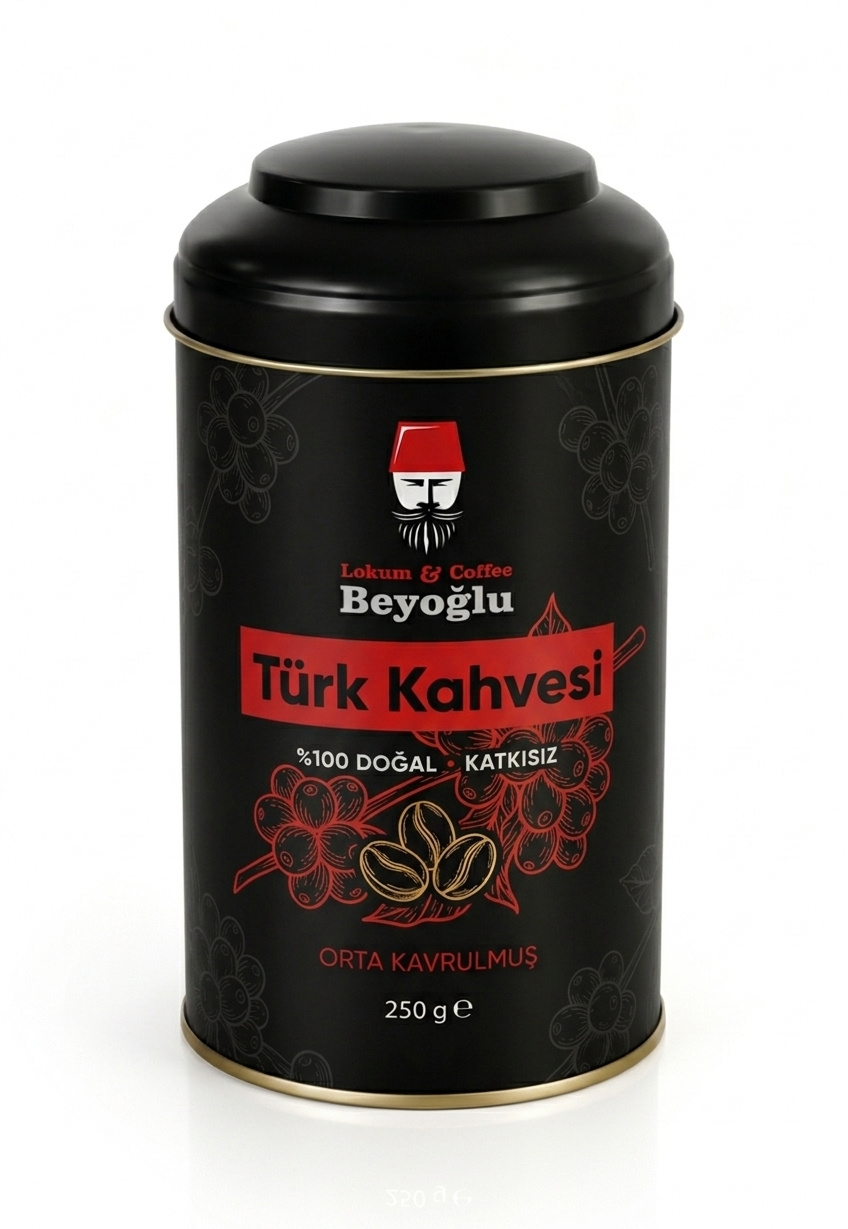
Beyoğlu Turkish coffee is made from 100% Ethiopian Arabica, medium roasted and extra-finely ground for the cezve. It comes in a 250 g metal tin. This powder-like grind is intended for Turkish brewing, rather than an automatic bean-to-cup machine.
For more on flavour choices, see Turkish coffee roasts and Turkish delight pairings.
Keep opened coffee closed and protected from moisture, heat and strong smells, following the pack's instructions. Buy an amount you can use while the aroma is still enjoyable.
10. How to serve Turkish coffee with water and lokum
Serve the coffee in a small cup, often alongside drinking water and a separate piece of Turkish delight. Water can refresh your palate before the first sip or between sips.
There is no compulsory flavour pairing. Pistachio, rose or a simpler lokum can provide a sweet contrast; fruit-flavoured versions offer another direction. Explore Beyoğlu lokum rolls and choose by taste and ingredients.
The tradition combines preparation with hospitality. Turkish coffee culture was inscribed on UNESCO's Representative List in 2013. That recognition concerns the cultural practice, not certification of a particular brand.
Read how Turkish coffee emerged, or try our companion guide to brewing Turkish tea.
Frequently asked questions
How much coffee do you put in a cezve for one cup?
Start with 7–8 g of extra-finely ground coffee and 65–75 ml of water for a small serving. Weighing is more repeatable than using an unspecified heaped spoon.
How long should Turkish coffee take to brew?
Usually a few minutes, depending on the pot, amount and heat source. Use the rising foam as the main cue and remove the pot before vigorous boiling, rather than relying on a universal time.
Can you make Turkish coffee on an electric stove?
Yes. Use a stable pot suited to the surface and lift it off when the foam rises. Residual heat means turning down the control alone may not prevent overheating.
Can you make Turkish coffee on an induction hob?
Yes, with an induction-compatible cezve or an appropriate adapter. A copper pot without a compatible base may not heat directly.
Do you need to boil Turkish coffee three times?
No. One controlled foam rise is a useful starting method. Some preparations include further short rises, but sustained vigorous boiling is not required.
Why is there no foam on my Turkish coffee?
Possible reasons include unsuitable grind, coffee that has lost freshness, an unsuitable pot size or uncontrolled heating. Check these variables rather than assuming repeated boiling will fix it.
Do you filter Turkish coffee?
No. The grounds settle in the cup after pouring. Drink gently and leave the dense sediment at the bottom.
Is Turkish coffee a type of bean?
No. The name primarily describes the grind, brewing method and serving tradition. Different coffee beans and roast profiles can be used.
When should you add sugar?
Before heating. Stirring sugar into the finished cup disturbs the foam and settled grounds.
Can you use espresso-ground coffee instead?
It will not reproduce the characteristic result as reliably. Turkish coffee generally needs a finer grind than espresso or filter brewing.
Sources and further reading
- Turkish Coffee Culture and Research Association: 7 Steps to Perfect Coffee.
- Specialty Turkish Coffee: a contemporary preparation guide.
- UNESCO: Turkish coffee culture and tradition.
- Türkiye Ministry of Culture and Tourism: Turkish coffee.
The ratios are practical starting points, not laboratory results for a particular batch of Beyoğlu coffee. Adapt the recipe to your water, pot, coffee and preferences.
Choose coffee ground for a cezve
Beyoğlu Turkish coffee is medium-roasted Ethiopian Arabica prepared with an extra-fine grind for Turkish brewing.