
A practical guide to brewing black tea the Turkish way
Quick answer: Brew Turkish black tea as a concentrate in the upper pot of a çaydanlık, keeping hot water in the lower pot. A useful first batch is 10 g of tea with 350 ml of water in the upper pot. Steep gently for about 15–20 minutes, then pour some concentrate into each glass and dilute with hot water to taste.
The essential idea is concentrate first, adjust each glass afterwards. Turkish tea does not have to be equally strong for everyone, and the upper pot should not be subjected to a prolonged rolling boil.
Here you will find starter ratios, a step-by-step method, ways to control strength, an alternative without a double teapot and explanations of Rize tea, tea glasses and instant fruit drinks.
1. What is Turkish tea?
In everyday Turkish use, çay usually means black tea served hot in a small glass. Its identity comes from the tea, preparation and social setting—not from adding spices or fruit flavouring.
The tea is commonly prepared in a two-pot system. One pot holds the strong infusion; the other supplies hot water for dilution. This makes it possible to serve a lighter or stronger glass from the same batch.
Tea culture in Türkiye and Azerbaijan was inscribed on UNESCO's Representative List of the Intangible Cultural Heritage of Humanity in 2022. The recognition concerns a shared cultural practice, not a certification of any commercial tea.
2. Which tea do you need? Rize, leaf grade and fruit powders
Rize is an important tea-growing region on Türkiye's eastern Black Sea coast. Tea also grows in other parts of the eastern Black Sea area.
Black tea comes from Camellia sinensis leaves that undergo processing including withering, rolling or other mechanical treatment, oxidation and drying. Sorting and processing can result in larger, broken or finer leaf particles.
Turkish tea, Rize tea and large-leaf tea are not interchangeable descriptions. One refers to origin or brewing tradition, another to a region, and the last to the physical form of the leaf.
What Rize tea does Beyoğlu offer?
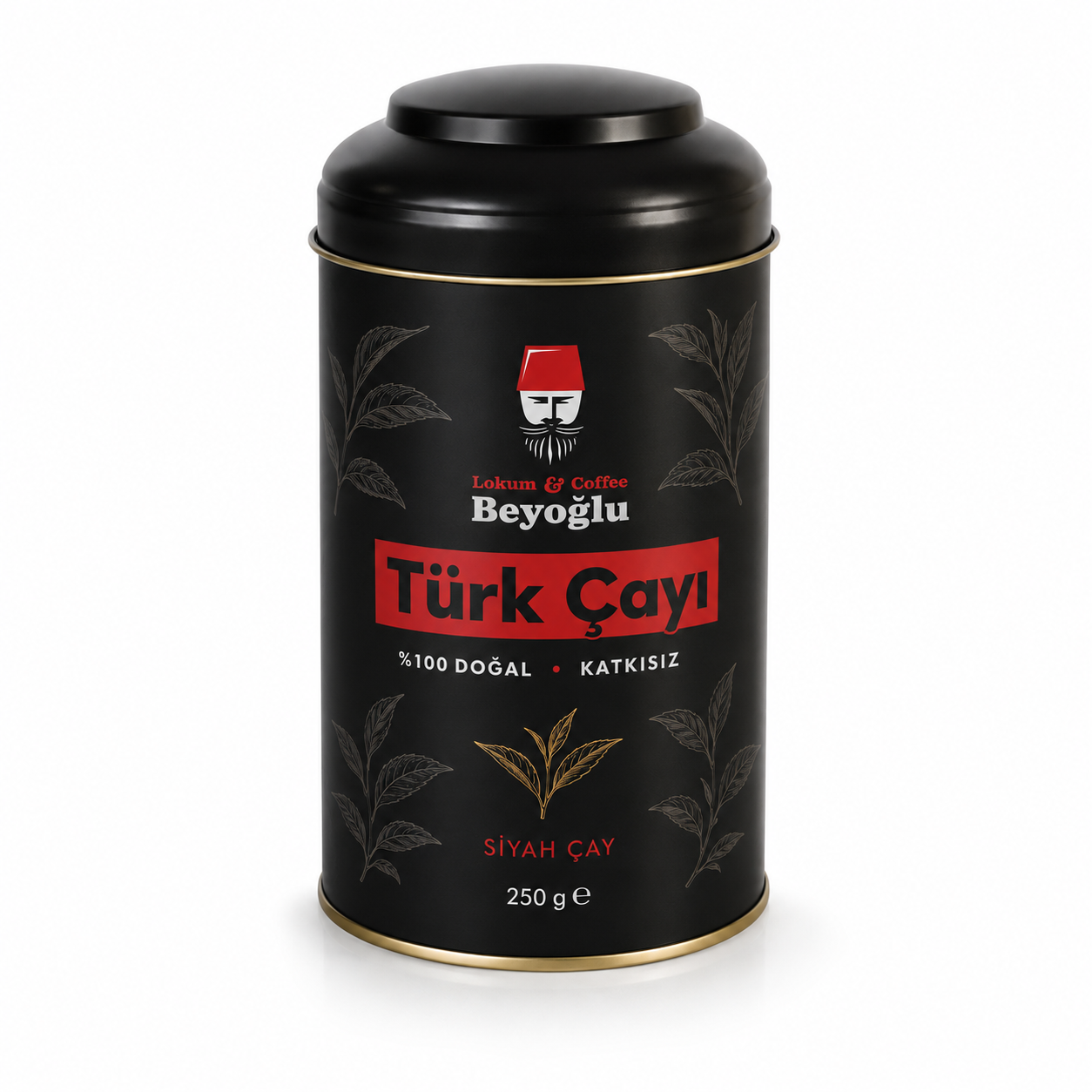
Beyoğlu Rize black tea is unflavoured black tea with a broken-leaf grade, packed in a 250 g metal tin. It is a leaf tea for infusion, rather than an instant fruit powder.
Use the instructions on the particular pack as your first reference. Leaf size and personal preferences affect the strength and timing that work for you.
3. What is a çaydanlık, and why are there two pots?
A çaydanlık is a stacked Turkish tea-pot system. The larger lower vessel heats water, while the smaller upper vessel holds the tea concentrate. Heat from below keeps the upper pot warm during steeping.
| Term | What it means | Role in preparation |
|---|---|---|
| Çaydanlık | The tea-pot system | Holds the two vessels used for brewing and serving |
| Lower pot | Hot-water vessel | Heats water and provides dilution water |
| Demlik | Upper teapot | Holds the leaves and concentrated infusion |
| Dem | Strong tea infusion | Is diluted in the glass |
| İnce belli bardak | Narrow-waisted tea glass | Used for traditional serving |
Keep the lower water hot while the upper infusion steeps gently. The aim is not to boil the tea leaves vigorously.
4. Turkish tea ratio: how much leaf and water?
For a first attempt, use 10 g of black tea and 350 ml of water in the upper pot, with extra water in the lower pot for dilution.
That is a concentrate ratio, not the ratio of the finished drink. The final strength and number of glasses depend on the size of the glass and how much hot water you add.
| Intended serving | Dry black tea | Water in the upper pot | Extra hot water for dilution |
|---|---|---|---|
| 2–3 small glasses | 5–6 g | 150–200 ml | 250–350 ml |
| 4–6 small glasses | 10–12 g | 300–400 ml | 500–700 ml |
| 8–10 small glasses | 16–20 g | 500–600 ml | 850–1,100 ml |
These are home-brewing starting points, not a fixed ÇAYKUR standard or a compulsory Beyoğlu recipe. Actual servings vary with dilution and glass size.
Turkish industry guidance sometimes measures tea by a spoonful per small glass. Weights are more repeatable because spoon sizes, leaf size and packing density differ.
If a batch is too strong, first try more dilution. For the next brew, you can adjust the leaf dose or steeping time rather than leaving the infusion to cook for longer.
5. How to brew Turkish tea in a double teapot
Ingredients and equipment:
- 10 g of Turkish black tea;
- 350 ml of water for the upper pot;
- extra drinking water for the lower pot and dilution;
- a çaydanlık and small serving glasses;
- sugar, if wanted.
Step 1. Prepare the water
Use fresh drinking water without an unpleasant smell or strongly mineral taste. Very hard water can affect the appearance and taste of the infusion.
Fill the lower pot with enough water to brew the tea and leave a supply for serving.
Step 2. Heat the lower pot
Bring the water to the boil. Meanwhile, check that the upper pot is clean and free of lingering aromas.
You can warm the upper pot with a little hot water and discard that water before adding tea.
Step 3. Add the leaves
Put 10 g of dry tea in the upper pot. Spread it gently if needed.
There is no need to crush or grind the leaves further.
Step 4. Add hot water to the upper pot
Pour approximately 350 ml of freshly boiled or slightly cooled hot water over the leaves so they become fully wet.
Black tea is generally brewed with water close to boiling. If necessary, refill the lower pot so there will be enough hot water for dilution.
Step 5. Stack the pots and reduce the heat
Place the upper pot on the lower one. Reduce the heat so the lower water stays hot and the upper infusion steeps gently.
Do not let the concentrated tea boil vigorously. Keeping it warm and boiling it hard are different actions.
Step 6. Steep for about 15–20 minutes
This is a common guide for the traditional method and is also the range given by ÇAYSİAD, the Turkish tea industry association.
Start timing after the hot water meets the leaves. Some finer teas may develop the preferred flavour sooner; other leaf grades may need longer. Taste and adjust future batches accordingly.
Step 7. Dilute each serving
Pour some strong infusion into the glass, then add hot water from the lower pot to reach the desired strength.
Serve sugar separately if wanted. Enjoy the tea freshly prepared: prolonged hot holding can make the flavour more astringent and less pleasant.
6. How strong should Turkish tea be?
There is a difference between the strength of the upper-pot infusion and the strength of the drink in your glass. Dilution is the simplest way to control the latter.
| Style | Approximate concentrate | Approximate hot water | Starting result |
|---|---|---|---|
| Açık çay | 1/4 of the glass | 3/4 of the glass | Lighter |
| Medium strength | 1/3–1/2 | 2/3–1/2 | Moderately full |
| Koyu çay | 2/3 | 1/3 | Stronger |
These are practical starting proportions, not universal serving rules for every household or region.
A darker glass is not automatically a better one. Aim for a flavour you enjoy, using the dose, time and dilution together.
7. How long do you steep Turkish tea?
About 15–20 minutes is a useful reference for the traditional double-pot preparation. It is not a compulsory timer setting for every black tea.
| Steeping time | What to consider |
|---|---|
| Under 10 minutes | The infusion may be too light for a traditional strong concentrate |
| 10–15 minutes | Some teas already develop substantial colour and flavour |
| 15–20 minutes | A common traditional brewing range |
| Beyond 25–30 minutes | The risk of excessive astringency or an unwanted flavour change increases |
Longer steeping is not a universal measure of quality. Industry recommendations to drink a prepared batch promptly concern flavour and aroma; they should not be converted into a universal food-safety expiry time.
8. Can you make Turkish tea without a çaydanlık?
Yes. Use an ordinary teapot for the concentrate and a separate kettle for hot water. You retain the main principle even though you lose the convenience of the stacked pots.
- Heat fresh drinking water.
- Warm the teapot and empty it.
- Add the measured black tea.
- Pour hot water over it and cover.
- Steep for roughly 15–20 minutes, adjusting for the tea and your taste.
- Pour some concentrate into a cup and dilute with separately prepared hot water.
Use heat-resistant vessels according to their manufacturers' instructions. A random glass or ceramic pot should not be placed directly on a burner.
A regular cup can also hold the finished drink. The glass shape is part of the serving tradition, rather than a chemical requirement for brewing tea.
9. Do you need to rinse Turkish tea?
Some Turkish brewing guidance recommends a brief warm-water rinse of the leaves. It is not a universal requirement for every tea.
Follow the particular pack's guidance. If rinsing is recommended, keep it brief rather than soaking the leaves repeatedly. Rinsing should not be used to try to fix an unpleasant smell or damaged tea.
10. Why does Turkish tea taste bitter or look cloudy?
| Problem | Possible cause | What to try |
|---|---|---|
| Too bitter or astringent | Too much leaf, too long a steep or boiling the concentrate | Reduce the dose or time; keep the infusion below a vigorous boil |
| Too weak | Low dose or insufficient steeping | Adjust the leaf weight and timing |
| Cloudy infusion | Water, tea characteristics or cooling | Check the water and preparation conditions |
| Unwanted smell | Storage odours or an unclean teapot | Use clean equipment and properly stored tea |
| Different strength between glasses | Inconsistent dilution | Use a repeatable concentrate-to-water balance |
| Tea cools before serving | Cold glasses or a delay | Serve promptly using suitable glassware |
Heat management matters throughout. The lower pot keeps water hot; the upper pot should not become a vigorously boiling saucepan of leaves.
11. Is Turkish black tea the same as instant apple or pomegranate tea?
No. Instant fruit drinks sold in Türkiye can be enjoyable products in their own right, but they are not necessarily black tea from Camellia sinensis leaves.
| Feature | Rize black tea | Instant fruit drink |
|---|---|---|
| Main form | Dried tea leaves | Powder or granules |
| Preparation | Infusion | Dissolving according to the label |
| Flavour | Black-tea character | Depends on the fruit ingredients, flavours and formulation |
| Sugar | Added if wanted | May already be included |
| Caffeine | Naturally present | Depends on the ingredients |
Check the label rather than inferring the contents from the word “Turkish” or a fruit name. A powder may contain sugar, food acids, flavourings, fruit ingredients or extracts, depending on its recipe.
12. How to serve Turkish tea
The traditional narrow-waisted glass is called an ince belli bardak. It is also described in English as tulip-shaped; armudu is another name often encountered in regional use and retail.
The clear glass lets you see the infusion's colour. You can still use a suitable small cup if you do not have traditional glasses.
Sugar can be offered separately. Lemon and sweetness are matters of preference, rather than compulsory additions. In the kıtlama tradition, tea may be sipped with a piece of sugar held in the mouth; this is one regional custom, not a rule for everyone.
Serve with Turkish delight or tahini halva if desired, checking the ingredients when choosing sweets for guests.
For another traditional drink, read how to make Turkish coffee in a cezve. For a business occasion, explore our guide to Turkish corporate food gifts.
13. Choosing and storing tea for home brewing
Look for clear information about origin, leaf grade, pack size and ingredients. Distinguish plain black tea from a flavoured blend or an instant drink.
Keep tea closed, dry and away from strong smells, following the pack's storage instructions. A good teapot cannot compensate for tea that has absorbed kitchen odours.
Beyoğlu's 250 g Rize tea is a broken-leaf black tea without added fruit powders or flavourings. Use a measured first batch, then adjust your own brewing routine.
Frequently asked questions
How much Turkish tea do you use in a double teapot?
Start with 10 g of black tea and 350 ml of water in the upper pot, plus additional hot water below for dilution. This is a concentrate recipe, not a fixed finished-drink ratio.
How long should Turkish tea brew?
About 15–20 minutes is a common reference for traditional double-pot brewing. Adjust for the leaf grade, water and desired flavour.
Why do Turkish teapots have two parts?
The upper pot holds concentrated tea while the lower pot supplies heat and hot water. Each glass can then be diluted separately.
Can you make Turkish tea in a normal teapot?
Yes. Brew the concentrate in a teapot and keep extra hot water in a separate kettle. Dilute in the cup before drinking.
Why is Turkish tea so strong?
It is often brewed as a concentrate. The finished glass can be light or strong depending on the amount of hot water added.
Should you boil the tea leaves?
Avoid prolonged vigorous boiling of the concentrate. Keep the lower water hot while the upper pot steeps gently.
What is a Turkish tea glass called?
The narrow-waisted glass is called an ince belli bardak. It is often described as tulip-shaped; armudu is another name encountered in regional contexts.
Is pomegranate tea the same as Turkish black tea?
Not necessarily. An instant pomegranate drink may be a fruit-flavoured mixture rather than black tea. Check the ingredient list.
Do you have to add sugar?
No. Sugar is optional and can be served separately. Adjust sweetness to taste.
Why is my Turkish tea bitter?
Possible causes include too much tea, excessive steeping or boiling the concentrate. Adjust those variables and the dilution rather than simply extending the brew.
Sources and further reading
- ÇAYSİAD: guidance for brewing tea.
- GoTürkiye: Tea Route.
- Türkiye Ministry of Culture and Tourism: Culture of Çay.
- UNESCO: Culture of Çay.
- Beyoğlu Rize black tea.
The ratio tables are practical starting points for home brewing. They do not establish a mandatory commercial recipe or a universal safety time for prepared tea.
Start with Rize black tea
Explore Beyoğlu’s unflavoured broken-leaf Rize tea, packed in a 250 g metal tin for traditional infusion.